RealGM Analysis
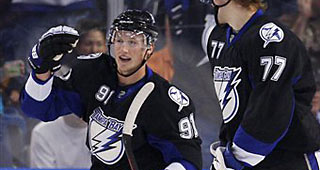
In just a few days, 23 players will face arbitration with their teams to determine what a fair contract for that player should be (unless they come to an agreement before hand). In addition, there are high profile free agents such as defensemen Drew Doughty of the Los Angeles Kings and Shea Webber of the Nashville Predators and the super-scorer Steven Stamkos of the Tampa Bay Lightning. These players are all bound to make in the neighbourhood of $6-8M annually for the foreseeable future and will be the cornerstones of whichever franchise they are with.
In the NHL, general managers consider offering a restricted free agent an offer sheet a direct insult to whoever holds the right of the players. Recall the Kevin Lowe/Brian Burke fiasco of 2007: the Oilers made signed Dustin Penner to an offer sheet of $21.25M over 5 years and by doing so infuriated the Anaheim Ducks, particularly Brian Burke. It is worth noting that Penner made $425,000 the previous year. There was no reason for the Ducks to match the offer sheet for a player who had only played 101 regular season NHL games and who had several young up and coming players (Getzlaf, Perry, Ryan anyone?). Both Burke and Lowe exchanged pleasantries throughout the process and were warned by the league to cut it out before fines and penalties came. At the end, the Edmonton Oilers got their player, and with the sliding compensation system of the NHL, the Ducks received a package of first, second and third round picks from Edmonton.
In 2008, the Vancouver Canucks gave the then 24-year old David Backes an offer sheet for $7.5M over 3 years which was matched by the St. Louis Blues. Exactly a week later, the Blues signed Steve Bernier of the Canucks to a 1-year/$2.5M deal, one that would pay him over his market value. The Canucks general manager Mike Gillis wasted no time matching the offer as the compensation for Bernier would only be a second round pick which is less than what Vancouver gave up for him (a second and third rounders). At the end, this seemed like another battle of general managers for a player and there was a sense of broken camaraderie.
What boggles my mind is that this is such a big deal in the NHL. The NBA, for instance, has a RFA system similar to that of the NHL, minus the compensation structure. A general manager of an NBA team is able to sign any restricted free agent to an offer sheet as long as they offer him a multiple year contract and certain percentage of his salary from the previous season. To give a quick example, the Toronto Raptors signed point guard Jarrett Jack to a 4 year, $20M+ offer sheet while he was a restricted agent with the Indiana Pacers. The Raptors front office knew that the Pacers would have a tough time matching such an offer, which turned out to be the case. There were no compensation picks, no arguments and behind the scenes comments. Just business.
If I were the general manager of a team with more than $10M and a bunch of my picks, I would not hesitate to give an offer sheet to Doughty, Stamkos or Webber. Here is the rationale:
1) Chances are if you pick one of these players up and you already have a decent core of role (say a team like Winnipeg or Florida), the 4 first round picks will be in the late teens/early 20s. Chances of finding a player of such high calibre as these RFAs are very slim.
2) The player himself.. these are young and energetic superstars. They will sell out home buildings 41 times during the regular season. They will interact with the fans and the media and will not shy away from being the face of a franchise. They are passionate about the game and are all high character guys.
3) As a general manager, you should be responsible for your own talent only and not for what other general managers think of you. I understand that it may become difficult to trade with a team that you signed a marquee free agent from, so be it. The first and foremost focus of an NHL GM should be to better the team and either of Doughty, Stamkos or Webber would do so instantaneously.
At the end of the day, running an NHL franchise is running a business. There are some general managers that played the RFA game well, take Bobby Clarke for example. In September of 2006, Clarke extended a $1.9M, 1 year offer sheet to Ryan Kesler of the Canucks. At that time, analysts and general managers alike were baffled at the notion that this offer was made, even though Kesler had only scored 10 goals in a full season previously, there was no doubt that the Canucks were going to match the offer sheet. After they did so, Clarke received a lot of heat for driving up salaries and not playing by the rules.
Clarke replied by saying he was attempting to improve his team and felt surprised he was the only one doing it.
To be honest, I am surprised at that too.
More stories: