RealGM Analysis
As the season begins, the number 40 will be a common theme for Leaf fans this year.
On May 2nd, 2007 the Leafs will ?celebrate? the 40th anniversary of the last time they won the Stanley Cup. That team that won in 1967, wasn?t even supposed to win that year. Much like the recent versions of the Leafs, they were a bunch of players who were past their prime and got hot at the right time. GM and coach Punch Imlach and owner Harold Ballard at that time refused to build up their farm systems. In fact they sold most of their farm teams, losing the rights to a lot of their prospects.
Before the league expanded to 12 teams from 6, they held intra-league drafts where they could claim unprotected players through other teams. During that time, the Leafs would usually leave their younger players unprotected, like future Hall of Fame goalie and forward Gerry Cheevers and Brad Park, and steady defenseman Pat Stapleton. That was the year that marked the beginning of the end for the Leafs Cup dreams for years to come.
Fast forward 40 years and we end up with the 2006-2007 version of the Maple Leafs. During the previous 8 years, the team was competitive, they were always in the playoffs while only losing in the 1st round once, and only missing the playoffs once. But like the 1967 Leafs, this team is aging and is at the point where they aren?t supposed to win. This leaves current general manager, John Ferguson Jr. in a similar situation as Imlach. He can either do the same as his predecessors and try and keep this team competitive to the point where they?re always competing for a playoff spot, while continuing to get playoff revenue, or they can tear the team apart and try to rebuild it so they?re competing for the Stanley Cup for a long period of time. The answer to this dilemma can only be answered by the actions they take with one player, Mats Sundin.
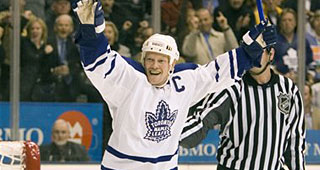
Mats Sundin was drafted 1st overall in the 1989 draft by the Quebec Nordiques. In 1994, Sundin along with Todd Warriner and Garth Boucher were traded to the Leafs for Wendel Clark, Slyvain Lefbvre, Landon Wilson and a 1st round draft choice. This move at the time was a pretty unpopular one, due to the popularity of Wendel Clark. However, Sundin went on to score 362 goals and 577 assists (as of Oct. 8, 2006) in his 11 years as a Maple Leaf while becoming the teams 16th captain, 1st European captain, in 1997 after Doug Gilmore was traded to the New Jersey Devils.
Sundin is everything a captain should be, he leads by example, he?s not afraid to get into a teammate?s face when he?s not playing the way everyone knows he can, and he always says the right things. He is loyal to the city of Toronto and if you listen to what he says in the media, he?d rather be a part of the solution for the Leafs, than be the cherry on the top for a contending team.
As a fan, I want to see Mats retire as a Leaf, in fact in a perfect world he would. I was recently asked what I would do to make the Leafs a contender if I was the general manager and didn?t have any pressure from the fans or management. Taking biases and sentimental feelings aside, the first thing you have to do is trade Sundin. The way the team is now, there?s not much you can do to improve it because of the salary cap. They are too close to the cap and wrapped up in too many long term contracts to really improve the team. This causes the team to be mediocre and be lucky to make the playoffs year after year until Sundin retires. Then you would be rebuilding anyways.
So the first obstacle is to convince Sundin to waive his no-trade clause. To be honest, I don?t think this is much of an obstacle because Mats is the type of person who knows when he is not wanted. If it gets to that point, he would probably waive his no-trade clause, even though it probably isn?t what he wants. This would truly be the last gift he can give the Leafs and their fans because it allows them to kick start the rebuilding mode by getting the players and prospects that makes the transition easier on the fans. What this also does is it sends a message to the rest of your team that the direction is changing. This would probably cause the other veteran players such as Bryan McCabe, and Thomas Kaberle to waive their no-trade clauses because they know the departure of Sundin means the team is going into rebuilding mode. Despite the large contracts that these guys have, they all have a lot of value on the trade market to get top notch prospects and draft picks from contending teams who are trying to win the Stanley Cup for the present.
After you are able to get rid of those three players, the rest gets easier. You can get top quality assets for people like Darcy Tucker because he is a player who wears his heart on his sleeve and is considerably cheap for a 30 goal scorer. Pavel Kubina will get a lot of interest from around the league at his $4 million per year salary because he has had experience as a #1 defenseman and has Stanley Cup winning experience. Then there will be a ton of teams willing to take on someone like Michael Peca and his leadership and his defensive skills. While there will always be teams who are willing to take a chance on players like Jeff O?Neil, Nik Antropov, and Hal Gill where you can get some form of draft choice for them.
At this point, you have a team full of young players that you have either just acquired or were already on your team while saving a whole bunch of room on the salary cap. This is also where as a GM you would leave things alone. You just let the young players play and whatever they win is just a bonus. On a team that already has players like Kyle Wellwood, Matt Stajan, Alex Steen, Ian White, Carlo Coliacovo, Steffon Kronwall, and Andrew Raycroft in goal, plus Justin Pogge coming up through the minors. That team would be entertaining, but will still do the job of building through the draft to get that superstar player to replace Sundin. The ideal year for that would be in 2009 when the next ?Next One? John Tavares is eligible for the Entry draft.
After a few years once the team really start to show that they can play in the NHL and really contend with the big boys, you start to fill in with veterans again VIA free agency. When all is said and done with this team, if done correctly, you will have a team that will be on the top half of the league, and would be a legitimate threat to win the cup every year.
In the end you would end up with a team that is probably better than this version of the Leafs in their prime. The difference between the two versions is that the team that I suggested in this article was built through the draft and young prospect while the other was mainly built through free agency. As well a team built mainly through has a shorter window to win due to the player?s age and declining productivity/performance.
Now the only problem with all of this is that this is unlikely to happen at the present time. Ferguson could have a chance to erase the mistakes of all his predecessors before him if management lets him, and unlike my scenario, he doesn?t. This year is the last year of Ferguson?s contract where it?s widely believed if he doesn?t make the playoffs or even if this team isn?t in contention at mid year, he will be fired or his contract will not be renewed. This means, if he wants to keep his job he has no choice but to keep Sundin and go for it now. But no matter who the general manager is, whether John Ferguson Jr. stays on and gets an extension or a new GM should realize it's autumn and the leafs are turning brown and orange. The only thing left to find out is when will the Leafs fall.
More stories: