RealGM Analysis
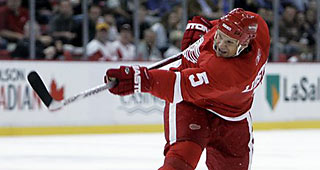
Last year’s successful campaigns by Nicklas Lidstrom (who won a Norris Trophy at 40-years-old), Teemu Selanne (80 points in 73 games at 40-years-old), and Mark Recchi (who won a Stanley Cup at 42-years-old) left us wondering: When did NHL players start aging like a fine wine? And who put up the best seasons while supposedly being over the hill?
Lidstrom’s 2010-11 season (16-46-62, -2, 82 games) narrowly edges out Ray Bourque’s 2000-01 campaign (7-52-59, +25, 80 games) by virtue of the Norris Trophy that Lidstrom won. And while the plus/minus stands out, Bourque had the luxury of playing with the league MVP that year (Joe Sakic), a mostly-healthy Peter Forsberg, and in front of Patrick Roy for the Stanley Cup Champions in Colorado; Bourque was arguably the fourth-best player on his own team that year.
Lidstrom was definitely the Wings’ best player last season, being an anchor while his team received inconsistent goaltending, inconsistent defense, and a very banged up offense. Oddly enough, 2000-01 marked the first of Lidstrom’s seven Norris Trophies, so Bourque wasn’t the league’s best defenseman, while Lidstrom was.
Selanne scored the third-most points by a player 40-years-old or older; Johnny Bucyk scored 83 points (in 77 games) in 1975-76, while Gordie Howe put up 44-59-103 in 1968-69. Adjusting for era and games played, and Selanne’s season is probably the second-best offensive season by a greybeard.
As well as Dwayne Roloson has played over the past two seasons, there has been better. The best season by a goaltender looking more like Father Time, was the 2006-07 version of Dominik Hasek, who was 42-years-old. Hasek had a 38-11-6 record, a 2.05 GAA and .913 SV% with eight shutouts.
It was also interesting to find out how many 40-somethings contributed significantly to Stanley Cup Champions. The answer: Six, including Recchi as noted above. Oddly enough, all five happened in the last decade: Recchi 2011, Bourque in 2001, Igor Larionov and Chris Chelios in 2002, Dave Andreychuk in 2004 and Hasek in 2008.
The key word there is “significant.” Undoubtedly, everyone has their own definition of what a significant contributor is to a hockey team, but for the purpose of this article, the following cutoffs were used: Skaters who contributed at least 40 points, 20 goals, or a +20 rating; for a goalie, the cutoff was simply 40 games played.
All in all, there were 27 such seasons by a skater; 24 seasons saw someone reach 40 points, plus two seasons saw a player reach +20 without getting to 40 points (both Chelios), and one season in which a player scored 21 goals (with 39 points, Andreychuk). There were also 12 seasons in which a goalie at least 40-years-old played 40 games.
Of those 39 such occurrences, one season fell in the 1920’s, one season in the 1930’s, and then it didn’t happen again until Johnny Bower’s 1967-68 season, followed by two Gordie Howe seasons in the 60’s. Howe had two more of these quality over-40 seasons in the 70’s, where there were a total of nine such seasons. The 80’s saw only one of these seasons, which was by Dave Keon in 1980-81 (47 points, -31), and there was a twenty year drought of quality over-40 seasons until 2000-01.
That 2000-01 season brought in a wave of quality super-veterans. Mark Messier had three of these quality seasons between 2000-04; Hasek had three straight from 05-08, and Larionov had three straight from 2000-02; Hall of Famer Ed Belfour had two very good seasons from 05-07. All in all, there were 21 quality seasons by 40-something NHL players between 2000-01 and 20009-10. Again, that was 21 in ten years, which was preceded by a 20-year drought!
That trend is continuing this decade, as we saw four quality seasons last year from Lidstrom, Selanne, Recchi and Roloson. Three of the four (Recchi retired after winning the Cup) are playing again this year, and are almost locks to put up another quality season.
And what about all of the players who signed very-long-term contracts - how many will play out the lifetimes of those deals that sometimes take them past 40-years-old? With improved training, improved nutrition, and improved medical practices, these may be just as common for the new couple of decades as we have seen recently.
Nick is RealGM’s NHL Feature Writer. You can reach him by email [email protected] or on twitter @NickObergan
More stories: